 Earwigs of Kenya
| country | species | [genera] | (endemic/cosmopolitan) | specimens collected | 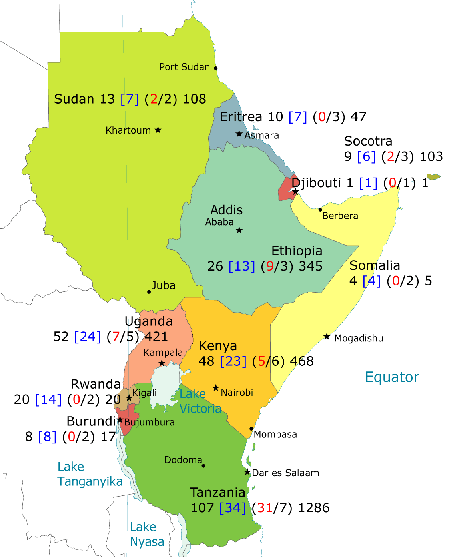 |
| Burundi | 8 |
[8] | (0/2) | 17 | |
| Djibouti | 1 | [1] | (0/1) | 1 | |
| Eritrea | 10 | [7] | (0/3) | 47 | |
| Ethiopia | 26 | [13] | (9/3) | 345 | |
| Kenya | 54 | [25] | (5/6) | 468 | |
| Rwanda | 20 | [14] | (0/2) | 20 | |
| Socotra | 9 | [6] | (2/3) | 103 | |
| Somalia | 4 | [4] | (0/2) | 5 | |
| Sudan | 14 | [7] | (2/2) | 120 | |
| Tanzania | 107 | [34] | (31/7) | 1286 | |
| Uganda | 52 | [24] | (7/5) | 421 |
Brindle A (1964) A revision of the African species of the genus Gelotolabis Zacher (Dermaptera: Carcinophoridae). Annals and Magazine of Natural History, Series 13 (Volume 7): 747-755.
Brindle A (1967) A key to the Ethiopian genus Diaperasticus Burr (Dermaptera: Forficulidae). Proceedings of the Royal entomological Society of London (B), 36: 147-152.
Brindle A (1969) A key to the African species of the genus Chaetospania Karsch (Dermaptera, Labiiade). Proceedings of the Royal entomological Society of London (B), 38: 95-100.
Brindle A (1973) The Dermaptera of Africa. Pt I. Annales du Musee Royal de l'Afrique Centrale Tervuren, Series no 8, Sciences Zoologiques, 205: 335 pp.
Brindle A (1978) The Dermaptera of Africa. Pt II. Annales du Musee Royal de l'Afrique Centrale Tervuren, Series no 8, Sciences Zoologiques, 225: 204 pp.
Burr M (1911) Dermaptera. Wissenschaftliche Ergebnisse der Deutschen Zentral-Afrika-Expedition 1907-1908 unter Führung Adolf A. Friedrichs Herzog zu Mecklenburg Part, 3 (0): 455-460.
Haas F (2005) Biogeography of Eastern African Dermaptera. 7. Annual Meeting of the GfBS in Basel, Switzerland. (250 KB, PDF)
Haas F, Häuser CL & Kinuthia W (2004) Earwigs (Dermaptera: Insects) of Kenya — new species and check-list. Poster. (600 KB, PDF). 5th International Symposium on Tropical Biology.
Haas F, Holstein J, Zahm A, Häuser CL & Kinuthia W (2005) Earwigs (Dermaptera: Insects) of Kenya - checklist and species new to Kenya. In: African Biodiversity: Molecules, Organisms, Ecosystems. Proc. 5th Intern. Symp. Trop. Biol., Museum Koenig, Bonn (B. A. Huber, B. J. Sinclair, K.-H. Lampe, eds.). 99-107.
Haas F & Häuser CL (2005) Biogeography of Dermaptera in Eastern Africa - elevation and humidity as factors for diversity. DGaaE Meeting in Dresden, Tropentag in Hohenheim. (900 KB, PDF)
Hincks WD (1943) Coryndon Memorial Museum Expedition to the Chyulu Hills - IX. Dermaptera. Journal of the East Africa Natural History Society, 17 (1&2): 33-38.
Hincks WD (1950) Some Dermaptera from Kilimanjaro, Tanganyika. Entomologist's Monthly Magazine, 86: 179-181.
Kevan DKMcE (1952) Dermaptera, Manteodea, Phasmatodea and Saltatoria collected by Dr. B. Benzon and Dr. F.W. Bræstrup in Southern and Central Kenya Colony. Entomologiske Meddelelser, 26: 222-230.
Kevan DKMcE (1954) Dermaptera from Northern Kenya. Entomologist, 87 (April): 75-76.
Koppenhoefer AM (1993) Egg predators of the banana weevil, Cosmopolites sordidus in western Kenya. Journal of Applied Entomology, 116 (4): 352-357.
Koppenhoefer AM (1995) Bionomics of the earwig species Euborellia annulipes in western Kenya (Dermaptera: Carcinophoridae). Entomologica Generalis, 20 (1-2): 81-85.
Koppenhoefer AM, Seshu Reddy KV, Madel G, Lubega MC (1992) Predators of the banana weevil, Cosmopolites sordidus (Germar) (Col., Curculionidae) in western Kenya. Journal of Applied Entomology, 114 (5): 530-533.
Seshu Reddy KV (1983) Studies on the stem borer complex of sorghum in Kenya. Insect Science and its Application, 4 (1-2): 3-10.
Further, detailed information on the Kenyan earwig fauna is available in the databases and in the link list.| Family | Subfamily | Species | Author | Notes and Common names | |
| 1 | Anisolabididae | Carcinophorinae | Anisolabis felix | (Burr, 1907) | |
| 2 | Anisolabis jeanneli | (Menozzi, 1938) | Locus Typicus, Endemic | ||
| 3 | Euborellia annulipes | (Lucas, 1847) | Cosmopolitan | ||
| 4 | Euborellia cincticollis | (Gerstaecker, 1883) | |||
| 5 | Euborellia tellinii | (Borelli,1908) | |||
| 6 | Gonolabis hincksi | (Brindle, 1964) | Locus Typicus, Endemic | ||
| 7 | Isolabiinae | Isolabis usambarana | (Verhoeff, 1902) | ||
| 8 | Apachyidae | Apachyinae | Apachyus depressus | (Palisot de Beauvois, 1805) | |
| 9 | Chelisochidae | Chelisochinae | Chelisoches morio | (Fabricius, 1775) | Cosmopolitan |
| 10 | Diplatyidae | Diplatyinae | Diplatys fella | Burr, 1911 | |
| 11 | Diplatys macrocephalus | Palisot de Beauvois, 1805 | |||
| 12 | Diplatys pictus | (Zacher, 1910) | Locus Typicus, Endemic | ||
| 13 | Diplatys ugandanus | Hincks,1955 | |||
| 14 | Haplodiplatys kivuensis | (Hincks, 1951) | |||
| 15 | Lobodiplatys coriaceus | (Kirby, 1891) | |||
| 16 | Forficulidae | Cosmiellinae | Cosmiella adolfi | (Burr, 1909) | |
| 17 | Cosmiella bilobata | (Brindle, 1973) | Locus Typicus | ||
| 18 | Cosmiella pygidiata | (Brindle, 1973) | Locus Typicus, Endemic | ||
| 19 | Diapersticinae | Diaperasticus bonchampsi | (Burr, 1904) | ||
| 20 | Diaperasticus erythrocephalus | (Olivier, 1791) | |||
| 21 | Diaperasticus sansibaricus | (Karsch, 1886) | |||
| 22 | Forficulinae | Forficula auricularia | Linnaeus, 1758 | Cosmopolitan | |
| 23 | Forficula beelzebub | (Burr, 1900) | |||
| 24 | Forficula cavallii | (Borelli, 1906) | |||
| 25 | Forficula lucasi | Dohrn, 1865 | |||
| 26 | Forficula senegalensis | Audinet-Serville, 1839 | Kakamega | ||
| 27 | Guanchia rehni | (Burr, 1953) | Locus Typicus | ||
| 28 | Guanchia sjoestedti | (Burr, 1907) | |||
| 29 | Hemimeridae | Hemimerinae | Hemimerus deceptus | Rehn & Rehn, 1936 | |
| 30 | Hemimerus hanseni | Sharp, 1895 | |||
| 31 | Hemimerus sessor | Rehn & Rehn, 1936 | Locus Typicus | ||
| 32 | Hemimerus vosseleri | Rehn & Rehn, 1936 | |||
| 33 | Karschiellidae | Karschiellinae | Bormansia africana | Verhoeff, 1902 | |
| 34 | Bormansia impressicollis | Verhoeff, 1902 | Locus Typicus | ||
| 35 | Bormansia meridionalis | Burr, 1904 | |||
| 36 | Labiduridae | Labidurinae | Labidura riparia | (Pallas, 1773) | Cosmopolitan |
| 37 | Nalinae | Nala lividipes | (Dufour, 1828) | Cosmopolitan | |
| 38 | Pygidicranidae | Echinosomatinae | Echinosoma afrum | (Palisot de Beauvois, 1805) | |
| 39 | Echinosoma concolor | Borelli, 1907 | |||
| 40 | Echinosoma occidentale | Bormans, 1893 | |||
| 41 | Echinosoma wahlbergi | Dohrn, 1863 | |||
| 42 | Pygidicraninae | Dacnodes caffra | (Dohrn, 1867) | ||
| 43 | Dacnodes separata | (Burr, 1908) | |||
| 44 | Dacnodes wigginsi | (Burr, 1914) | |||
| 45 | Spongiphoridae | Geracinae | Pseudovostox truncatus | Brindle, 1970 | Locus Typicus, Endemic |
| 46 | Labiinae | Labia minor | (Linnaeus, 1758) | Cosmopolitan | |
| 47 | Paralabella borellii | (Burr, 1908) | Locus Typicus | ||
| 48 | Paralabella curvicauda | (Motschulsky, 1863) | |||
| 49 | Sparattinae | Chaetospania pauliani | Hincks, 1948 | ||
| 50 | Chaetospania rodens | Burr, 1907 | |||
| 51 | Spongiphorinae | Marava arachidis | (Yersin, 1860) | ||
| 52 | Spongovostox assiniensis | (Bormans, 1893) | |||
| 53 | Spongovostox marginalis | (Thunberg, 1827) | Locus Typicus | ||
| 54 | Spongovostox quadrimaculatus | (Stal, 1855) |